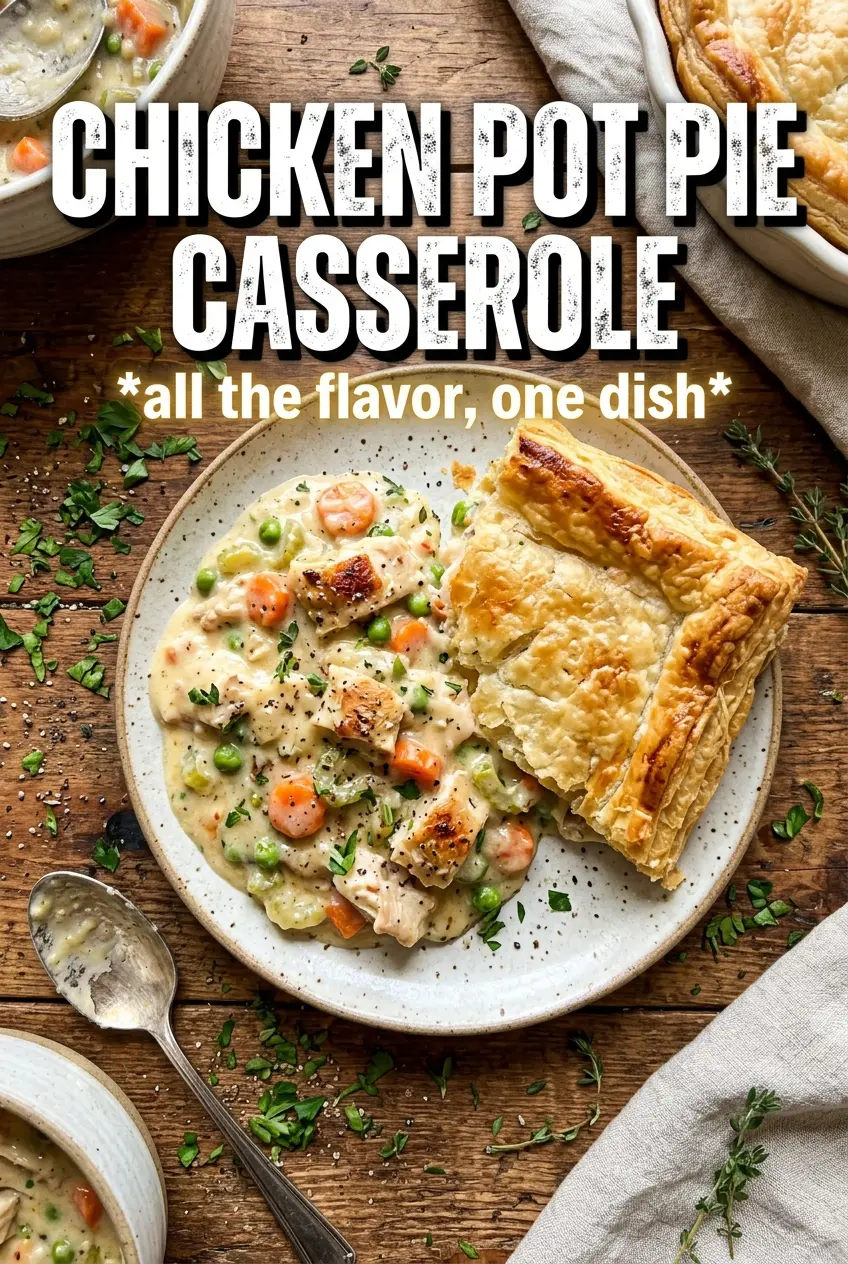
Chicken pot pie casserole delivers all the comfort of the classic pie without the stress of rolling, crimping, or waiting on a bottom crust to behave. The filling turns silky and rich, the vegetables stay tender but not mushy, and the biscuit topping bakes into a golden lid that gives each spoonful a little crunch before it melts into the creamy sauce underneath. It’s the kind of dinner that gets quiet at the table for a minute, which is usually a good sign.
The version I keep coming back to starts with a quick roux in the same pan that softens the onion, carrots, and celery. That step matters because it gives the sauce body before the broth and cream go in, so you don’t end up with a thin filling that pools at the bottom of the dish. Frozen peas and corn go in at the end so they stay bright and sweet instead of turning dull and overcooked.
Below, I’m breaking down the part that keeps the filling thick, the ingredient swaps that actually work, and the best way to handle biscuits versus puff pastry so the top bakes the way you want it to.
The filling thickened up beautifully and the biscuits stayed crisp on top instead of getting soggy. I baked it until the gravy was bubbling around the edges, and that made all the difference.
Save this chicken pot pie casserole for the nights when you want a creamy filling and a biscuit topping that bakes up deeply golden.
The Trick Most Casseroles Miss: Thick Sauce Before the Oven
The biggest mistake with chicken pot pie casserole is sending a thin filling into the oven and hoping it will sort itself out. It won’t. The heat has to work against all that liquid, and by the time the top is brown, the center still tastes loose and soupy. The roux fixes that before baking starts, which means the sauce sets into a spoonable, gravy-like filling instead of staying runny.
That first minute of cooking the flour in butter matters more than most people think. Raw flour can taste chalky, and a rushed roux doesn’t thicken as smoothly. You want the mixture to look pasty and smell a little nutty before you stream in the broth and cream.
- Roux base: This is what gives the casserole body. A cornstarch slurry won’t give the same savory depth, and it can turn glossy in a way that feels less like pot pie and more like takeaway gravy.
- Heavy cream: It softens the broth and gives the filling that classic pot pie richness. Half-and-half can work in a pinch, but the sauce will be a little lighter and less plush.
- Frozen peas and corn: These are best added at the end because they only need a quick warm-through. If you simmer them with the sauce for too long, they lose their pop and the filling tastes flat.
- Biscuits or puff pastry: Biscuits give you a sturdier, more rustic top that soaks up some gravy. Puff pastry bakes flakier and lighter, but it needs the filling beneath it to be thick enough or the bottom can turn soft.
What Each Part Is Doing in the Dish

- Cooked chicken: Rotisserie chicken is the easiest shortcut here because it’s already seasoned and tender. Leftover roast chicken works just as well, but avoid anything heavily sauced or smoked unless you want that flavor to take over the whole dish.
- Butter, flour, broth, and cream: This is the backbone of the casserole. The butter carries the flour, the broth brings savory depth, and the cream rounds everything out so the sauce clings to the chicken and vegetables instead of sliding off them.
- Onion, celery, and carrots: These need a short sauté before the sauce builds. If you skip that step, they stay too sharp and crunchy for a casserole that’s supposed to eat like comfort food.
- Fresh thyme and garlic powder: Thyme gives the filling that unmistakable pot pie note, while garlic powder adds warmth without making the sauce taste like garlic bread. Fresh thyme is better than dried here, but if dried is all you have, use a smaller amount because the flavor is more concentrated.
Building the Filling So It Stays Creamy, Not Watery
Softening the vegetables first
Cook the onion, carrots, and celery in butter until the onion turns translucent and the carrots start to lose their raw edge. You’re not trying to brown them hard here. You’re just giving them a head start so they finish tender inside the casserole instead of crunching under the topping.
Cooking the flour long enough
When the flour goes in, stir it through the vegetables until everything looks coated and slightly thickened. Let it cook for about a minute. If you move too fast here, the sauce can taste dusty later, and that raw flour flavor is hard to hide once the casserole is baked.
Adding the liquids slowly
Pour the broth in gradually while whisking or stirring constantly, then add the cream. The mixture should go from messy and paste-like to smooth and velvety. If it looks lumpy at first, keep stirring; most of the time it settles out as the sauce heats and thickens.
Finishing with chicken and vegetables
Stir in the chicken, peas, corn, thyme, and garlic powder after the sauce has thickened on the stove. This keeps the chicken tender and the vegetables bright. The filling should look thick enough to mound slightly in the spoon, because it will loosen a touch as it bakes under the topping.
How to Adapt This Casserole for What’s in Your Kitchen
Use puff pastry instead of biscuits
Puff pastry gives you a flakier, more elegant top and bakes faster than biscuits. Cut it to fit the dish, lay it over the filling, and bake until deeply golden. The tradeoff is that it softens more quickly under steam, so serve it soon after baking if you want the best contrast.
Make it dairy-free
Use plant-based butter and an unsweetened, full-bodied non-dairy cream, like oat or cashew cream. The filling won’t be quite as lush as the version with heavy cream, but it will still thicken well if you keep the roux and simmer the sauce long enough before baking.
Make it gluten-free
Swap the flour for a gluten-free all-purpose blend that includes a binder, and use gluten-free biscuits or a gluten-free pastry if that’s what you’re topping it with. The sauce may need another minute on the stove to reach the same thickness, so judge it by the way it coats the spoon.
Stretch it for a bigger crowd
You can add another cup of chicken and a little extra vegetable mix without changing the method. If you do, give the sauce a few extra minutes on the stove so it stays thick enough to support the added filling. A crowded pan can look done on top before the center is hot, so bake until the edges are bubbling steadily.
Storage and Reheating
- Refrigerator: Store leftovers for up to 4 days. The biscuit top softens in the fridge, but the filling stays creamy.
- Freezer: This freezes well if you freeze the filling separately from the topping, or bake and freeze individual portions. Puff pastry is the less reliable option after freezing because it loses some of its crispness.
- Reheating: Reheat covered at 350F until hot in the center, then uncover for the last few minutes so the top re-crisps. The biggest mistake is blasting it in the microwave the whole time, which turns the topping rubbery and can make the filling split.
Answers to the Questions Worth Asking
Chicken Pot Pie Casserole
Ingredients
Equipment
Method
- Preheat the oven to 400F. Set up a 9x13 dish so it’s ready for the casserole.
- In a Dutch oven, sauté onion, carrots, and celery in butter for 5 minutes. Cook until the vegetables soften and start to smell fragrant.
- Whisk in the flour and cook for 1 minute. Stir until the mixture looks smooth and lightly golden.
- Gradually add chicken broth and heavy cream, whisking as you pour. Simmer until thick, with a spoonable consistency.
- Stir in chicken, peas, corn, thyme, and garlic powder, then season with salt and pepper to taste. Mix until the filling is evenly combined and hot.
- Pour the filling into a 9x13 dish. Spread into an even layer so the topping bakes uniformly.
- Top with refrigerated biscuits or puff pastry. Tuck the edges slightly so they sit on the filling.
- Bake for 25-30 minutes at 400F until golden and the filling is bubbling. Look for visible steam from the edges and a browned, set topping.